Vor etlichen Monaten hatte ich mich auf der JoinDiaspora-Website in die Warteliste eingetragen. Mir gefiel die Idee einer Alternative zu Facebook. Als ich heute die E-Mail erhalten hatte, dass Diaspora Alpha online ist, klickte ich gleich auf den Link und weiter zur Registrierung. Da bekam ich dann zu lesen:
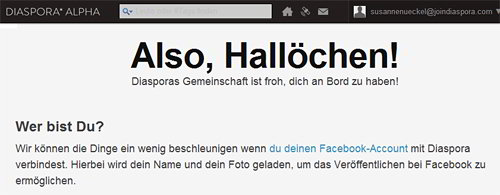
Es scheint, dass sich Datenschutz-Schutz, Usability und Marketing („hol die Leute dort ab, wo sie sind!“) an einer Kreuzung getroffen, aber nur die beiden letzteren den Weg fortgesetzt haben.
Mal genauer hinsehen:
a) Vielleicht hatte ich das Projekt ja idealisiert oder falsch in Erinnerung? Bei kickstarter beschreibt es sich so (Hervorhebungen von mir):
„What is it?
Enter your Diaspora “seed,” a personal web server that stores all of your information and shares it with your friends. Diaspora knows how to securely share (using GPG) your pictures, videos, and more. When you have a Diaspora seed of your own, you own your social graph, you have access to your information however you want, whenever you want, and you have full control of your online identity. Once we have built a solid foundation, we will make Diaspora easy to extend to facilitate any type of communication, and the possibilities will be endless.
For a little more detailed explanation, checkout this blog post.
Why are we building it?
This February, Eben Moglen, Columbia law professor and author of the latest GPL, gave a talk on Internet privacy. As more and more of our lives and identities become digitized, Moglen explains, the convenience of putting all of our information in the hands of companies on “the cloud” is training us to casually sacrifice our privacy and fragment our online identities.
But why is centralization so much more convenient, even in an age where relatively powerful computers are ubiquitous? Why is there no good alternative to centralized services that, as Moglen pointed out, comes with „spying for free?” Why do we keep our personal data in a thousand places? We have the technology, someone just needs to take the time to figure out how we can communicate smoothly and intuitively, without the hidden costs of “the cloud”. As good programmers, when we noticed that the application we need doesn’t exist, we set out to fill the hole in our digital lives.“
b) Werden also die zwei Grundsätze
- alle deine Daten an einem Ort
- nur du hast Zugriff auf deine Daten
mit dieser Aufforderung, eine Verbindung zu Facebook herzustellen, verletzt? Nein. Es werden nur Daten geholt. Aber wie genau wird das gemacht?